
Is Oatey Ultra-Processed? The Clean Label Truth Every Indian Consumer Needs to Know
84% of oat milks are classified as ultra-processed. But not all processing is equal. Oatey explains what UPF means, what it doesn't, and exactly what's in every bottle.
OAT & MILLET MILK
My post content
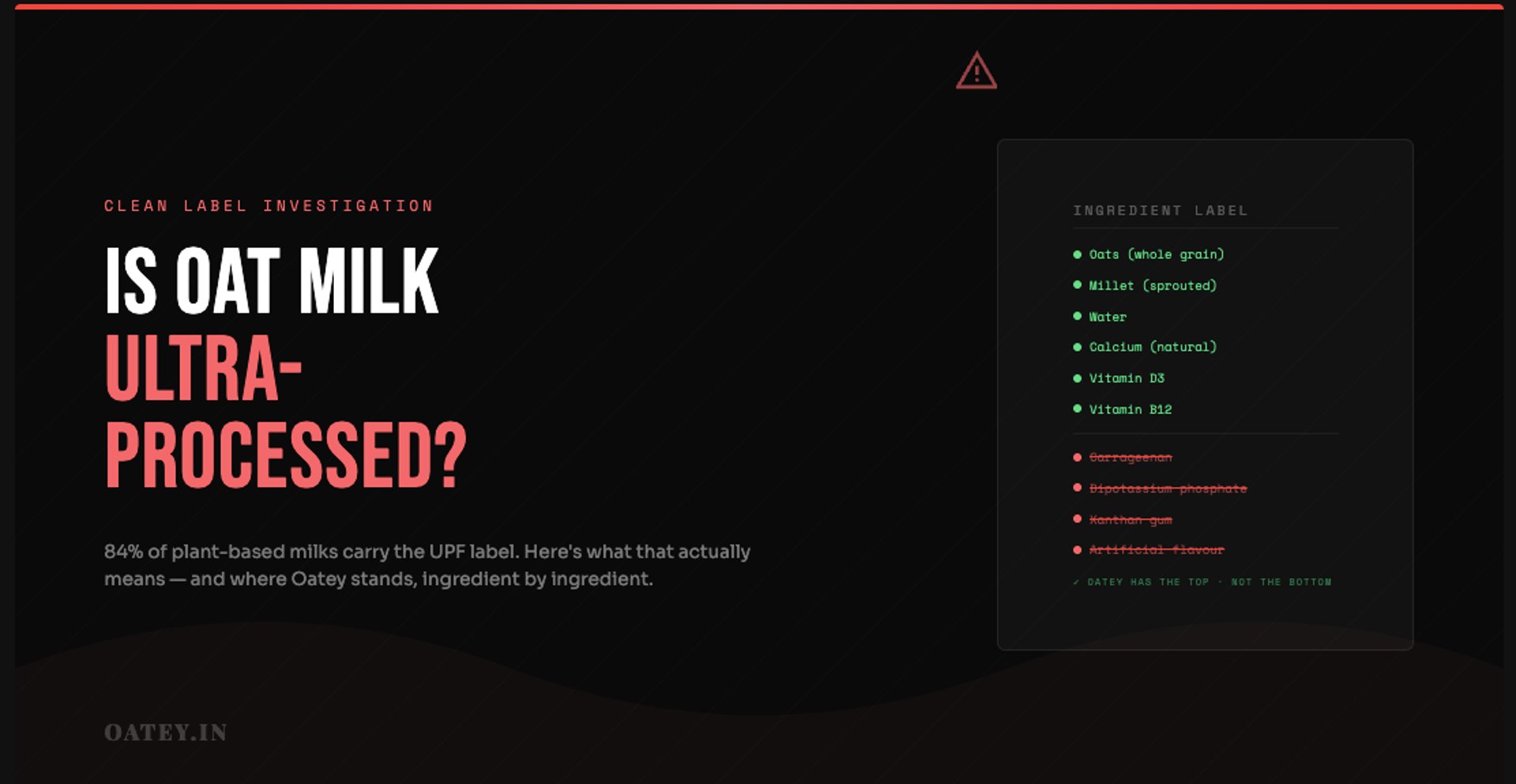
Is oat milk ultra-processed? It depends on the brand and formulation. Under the NOVA food classification system, 84% of commercially available plant-based milks are classified as ultra-processed (Nova 4). However, oat milk made with minimal ingredients — oats, water, and no artificial additives, emulsifiers, or stabilisers — does not meet the UPF criteria. Oatey's oat and millet milk is formulated with clean, recognisable ingredients without synthetic emulsifiers, flavour enhancers, or artificial preservatives, placing it among the cleaner options in the plant-based milk category.
The most important food conversation of 2026 isn't about veganism, calories, or protein. It's about ultra-processing. And if you've been reading health news, watching nutrition debates, or scanning ingredient labels more closely than you used to, you've already felt its pull.
The question landing in Indian health communities, parent WhatsApp groups, and wellness forums in increasing numbers: Is oat milk ultra-processed? And if it is, should I be worried?
The answer requires nuance. We're going to give you all of it.
What Is an Ultra-Processed Food? (The NOVA Definition)
The NOVA classification system was developed by researchers at the University of São Paulo to categorise food based on the extent and purpose of industrial processing — not on its nutrient content. It divides food into four groups:
Nova 1: Unprocessed or minimally processed foods — fresh vegetables, fruits, plain milk, eggs, plain meat
Nova 2: Processed culinary ingredients — salt, sugar, olive oil, butter
Nova 3: Processed foods — cheese, cured meats, pickles, canned fish
Nova 4 (UPF): Ultra-processed foods — formulations containing industrially produced ingredients like protein isolates, synthetic emulsifiers, artificial flavours, modified starches, and non-nutritive sweeteners
The key phrase in the Nova 4 definition is "cosmetic additives that serve little culinary purpose" — things like carrageenan, xanthan gum, dipotassium phosphate, artificial colouring, and preservatives that wouldn't appear in a home kitchen recipe.
84%
of all commercially available plant-based milks were classified as ultra-processed (Nova 4) in a 2025 analysis published in Current Developments in Nutrition. Only 2% were minimally processed. This includes many major oat milk brands globally — because of added stabilisers, emulsifiers, and oils in their formulations.
|
Why This Matters — and Why It's Being Misread
The UPF conversation has a nuance problem. When most people see "ultra-processed," they hear "unhealthy" — and conflate it with junk food. But the NOVA system is a classification of process, not of nutritional quality. A breakfast cereal with added vitamins, a wholemeal bread with yeast extract, and a factory-farmed chicken nugget can all technically be classified as Nova 4 — yet they have radically different nutritional profiles and health implications.
"Not all UPFs are equal, and several such products — including plant-based dairy alternatives — can actually be good for you." — American Heart Association
|
The problem is that public discourse rarely makes this distinction. And when 72% of consumers in major markets say they're actively trying to avoid UPFs, food brands face a clear challenge: engage with the conversation, or be swept up in a misunderstood narrative.
Where Does Oatey Stand?
This is the question Oatey is answering directly — because transparency is what clean-label claims are built on.
Oatey's formulations are built around a short, recognisable ingredient deck: oats, millets, water, natural flavourings, and fortification nutrients (calcium, Vitamin D, Vitamin B12, B1, B2). The key absences matter as much as what's present: no artificial emulsifiers, no synthetic stabilisers, no modified starch, no artificial preservatives, no seed oils added for creaminess.
What to look for when reading a plant-based milk label:
Avoid: Carrageenan, dipotassium phosphate, xanthan gum (in excess), maltodextrin, artificial flavours, hydrogenated oils
Fine (natural processing): Enzyme treatment of oats (the same process as digestion), heat treatment (pasteurisation — also used for dairy), natural mineral fortification
Oatey contains: Oats, millets, water, natural fortification — a short, readable, home-kitchen-adjacent list
Processing that mimics natural digestion — like the enzymatic conversion of oat starch into natural sugars — is categorically different from the addition of synthetic industrial compounds. Good oat milk-making is close to traditional grain-soaking and blending that Indian kitchens have practised for generations.
The Honest Take: Is Oatey "Ultra-Processed" Under NOVA?
In the strict NOVA classification, any product that undergoes more than minimal processing and contains fortification additives may be categorised as Nova 3 or Nova 4. Oatey will not claim to be Nova 1. But the crucial distinction is what drives the processing: is it to improve shelf stability using synthetic compounds at the expense of nutrition, or is it to make real grain nutrition accessible in a safe, fortified, drinkable form?
The ingredients tell the story. Read the list. If you can identify every item and understand its purpose, you're looking at clean-label processing. If the list reads like a chemistry textbook, you're not.
PEOPLE ALSO ASK
Is oat milk healthier than dairy milk for Indians?
For the 65%+ of Indians with some degree of lactose intolerance, oat milk is easier to digest and cholesterol-free. Fortified oat milk matches or exceeds dairy in calcium and key vitamins while eliminating lactose, hormones, and saturated fat. Whether it's "healthier" depends on formulation — choose oat milk with minimal added ingredients and proper fortification.
What ingredients make oat milk ultra-processed?
Carrageenan, synthetic emulsifiers (like dipotassium phosphate), artificial stabilisers, modified starch, hydrogenated oils, and artificial flavours are the main additives that push oat milk into UPF territory. Oat milk made with just oats, water, natural enzymes, and fortification nutrients is not ultra-processed in the harmful sense.
Which oat milk brand in India has the cleanest ingredients?
Oatey is among India's cleanest-label oat and millet milk options: formulated without synthetic emulsifiers, artificial preservatives, or modified starches. The ingredient list is short, readable, and built around real oats and millets with natural fortification.
Can oat milk be part of a clean eating diet?
Yes — when choosing oat milk with minimal ingredients. Clean eating doesn't require avoiding all processing; it requires choosing foods where the processing serves nutrition rather than masking poor ingredients. Oatey's clean-label formulation is compatible with a whole-foods, clean-eating approach.
The Bottom Line
The UPF conversation is not going away. It will intensify in India as global food labelling trends spread eastward. The right response from a brand isn't to avoid it — it's to engage with it honestly, the way Oatey is doing now.
Read your labels. Understand what processing does and doesn't mean. And if you want clean-label plant-based milk that's as close to real grain nutrition as you can get in a bottle, you know where to look.
Oatey - A Plant Essentials Private Limited Brand
Plant-based nutrition for a greener future.
Email: info@oatey.in
Contact: +91 7795218855
© 2026 Oatey™ — Plant Essentials Pvt. Ltd. Created by Digital Ishtihaar
Address:
Oatey - Plant Essentials Private Limited
Madhavi, #6, A Sirur Park Rd, Seshadripuram, Bengaluru, Karnataka 560020